BAGAS BREST DHE'N DIR PRI
bagas brest dhe'n dir pri
Brass Bands of the Clay Country
Introduction

The area comprising Cornwall’s Clay Country is blessed with some excellent brass bands and these, together with others which no longer exist, are a part of Cornwall’s rich brass band heritage.

Brass bands did not suddenly appear in a blue flash moment: no one said, “I know, I’ll invent the brass band”. Mankind’s appreciation of music began long before the days of the cornet or the euphonium and although we look upon this genre as being a part of our traditional musical world we can only trace it back to the mid-1800s when it emerged from the shadow of its true ancestor, the reed and brass movement.

During the latter half of the nineteenth century and the first half of the twentieth, the brass band enjoyed great popularity and found itself firmly at the heart of every Cornish community. It had an unrivalled place and was in constant demand at the countless secular and religious events. The period became known as the Golden Age of brass bands and reflected the fact that almost every village and town clamoured to have its own. There was immense pride as your band competed against others on the contest stage and for the players there was real pleasure in taking part, a satisfaction in being a member of such an important group.

Brass bands no longer have that pivotal role in society but although the number of bands has reduced dramatically, the level of proficiency of both instruments and players has improved to such an extent that the standard now achieved would cause us to reflect that the true Golden Age of brass bands is still with us.

In this part of the Music from the Clay Country project we include what we know of the Clay Country bands: their important milestones, the type of events they graced with their presence and, where possible, the names of their players.

We have drawn on the work of the late John Brush, an enthusiastic researcher, and the records of the China Clay History Society which has made available its extensive range of photographs. Others have contributed and they have been credited in the many pages of this project. All of them deserve our appreciation for contributing to this permanent record of the brass bands of the Clay Country.
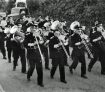
Penwithick or Penwithick Stents is a village 2.5 miles north of St Austell, in the civil parish of Treverbyn in the ‘clay country’ area   1919 circa: “Penwithick Band formed by some of the many bandsmen living in the St Austell area who had played in brass bands before the
Nanpean is a village approximately 4 miles north-west of St Austell (Shown spelt as Nepear which we assume is an error)   A few mentions of Nanpean Band leads us to the conclusion that a brass band was formed there sometime around the middle of the 19th century. It is
Foxhole is a village in mid-Cornwall within the parish of St Stephen-in-Brannel   We do not know the year in which Foxhole Band was formed but it was certainly prior to 1886 when the players travelled to Newquay to compete in the sixth Annual County Volunteer and Independent Brass Band
Indian Queens is a village situated west of Goss Moor and north of Fraddon approximately ten miles west-southwest of Bodmin   My thanks for the material from the book Indian Queens Band – A Photographic History by Dick Coles Indian Queen’s Band founder Martin Strongman Kessell (Photo: courtesy Dick Cole)
These photographs are all that has been found about Coombe Brass Band and, even then, we are not certain that the second one is correctly attributed. We would love to have that confirmed or, indeed, to receive any information at all about this band. Coombe Band 1912 (Photo: courtesy Alan
Greensplat is a location in south Cornwall immediately west of Carthew and approximately two miles north of St Austell   1914 – July: Greensplat Brass formed. (Greensplat Band minutes – CCHS) Greensplat Band circa 1914 (Photo: courtesy CCHS) 1914 to 1919: Renan Hancock Greensplat Band MD. (Band minutes – CCHS)
Fraddon is a village in mid Cornwall in the parish of St Enoder roughly midway between Newquay and St Austell   1910: Fraddon Coronation Band formed to celebrate the Coronation of George V. (RCG 21st September 1911) 1910: A Bullock, first Fraddon Coronation Band MD. He was also involved with
Enniscaven is a hamlet 5 miles north-west of St Austell and near to Goss Moor   Pre-1933: Enniscaven Brass Band formed. (John Brush) The life of this Enniscaven Brass Band seems to have been limited to the 1930s when several newspaper reports confirm its existence. 1934: Enniscaven Band with Mr
Fowey is a small town, civil parish and cargo port at the mouth of the River Fowey in south Cornwall     1834: The Royal Cornwall Gazette of the 13 September records that: “Upwards of two thousand were present [when] the Fowey Amateur Band added much to the gaiety and
Cornish Brass Band Contest results are recorded separately and can be found using this link   From the band’s website we see that the St Dennis Band was formed in 1836, in time for it to become a part of the celebrations for Queen Victoria’s Coronation in June 1838. At