

An historic organ in a reputedly haunted location!
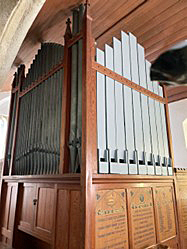
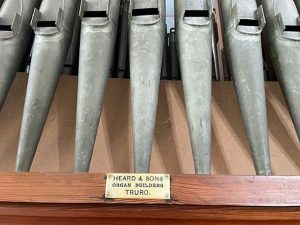
The hamlet of Warleggan up on Bodmin Moor was once regarded as one of the most remote settlements in Cornwall until it was linked by a road to the A38 in the 1950s. The church of St Bartholomew houses an organ built in 1920 by Heard & Sons of Truro. Heard was an established business of music retailers and instrument suppliers when, in 1895, it took over the organ building business of Brewer & Co of Truro. The two key-players of the Brewer firm, Thomas Brewer and William Brewer, moved to Heard: Thomas as foreman until his death in 1906, and William as voicer and tuner until he died in 1920.
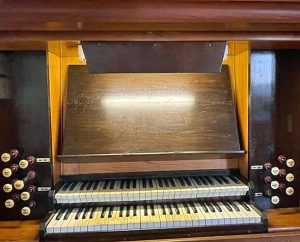
The Warleggan instrument is representative of Heard’s output of smaller organs from the later years of the company’s operation, and examples that survive unaltered and in their original home are becoming scarce. It was built as a war-memorial organ, funded by public subscription, and bears the names of the fallen from the village on plaques mounted under the Pedal Bourdon pipes on the west-facing case. It is listed on the War Memorials Register as the ‘Peace and Victory Organ’. For many years the organ had to endure a very damp environment because of issues with the roof of the church, but, following repairs to the roof, a grant was awarded in 2012 by the War Memorials Trust for the organ to be completely dismantled and to be thoroughly cleaned, repaired and overhauled, the work carried out by David Gridley of Penzance. Woodwork that had been attacked by woodworm was replaced on a like-for-like basis. There were no alterations to either the original actions or tonal specification, and the keys, pedalboard and draw-stops are also original.
There is nothing pretentious about this organ but, despite its very modest specification, it has much character. The principals and flutes of the Great division are boldly voiced, a feature also found in Brewer’s work, and a gentler Dulciana shares its bass pipes with the Clarabella. The Swell principals are smaller in scale than the Great, with the Gemshorn matched to the Diapason. The Gedact has a mild chiff and the strings are very telling, especially so the Gamba. Both the Diapason and Gamba share the bass pipes of the Gedact. The technical specification of the organ is as follows:
Pedal 30 notes
Bourdon 16
Great 56 notes
Open Diapason 8
Clarabella 8
Dulciana 8
Principal 4
Harmonic Flute 4
Swell 56 notes
Open Diapason 8
Gedact 8
Gamba 8
Voix Celeste 8
Gemshorn 4
Swell to Great
Swell to Pedal
Great to Pedal
4 combinations pedals, hitch-down swell pedal
The Warleggan organ is a robust little instrument with a musical tonal scheme that belies its small number of speaking stops. Given also its relative rarity and status as a war memorial instrument, in June 2025 the British Institute of Organ Studies recognised these merits by awarding it a Grade II Historic Organ listing with the following citation:
A representative example from 1920 of the later output of Heard & Sons of Truro, a regional firm that was active in the early decades of the 20th century. It remains unaltered in its original home and is listed in the War Memorials Register as the ‘Peace and Victory Organ’.
Jeffrey Williams
Organist & Director of Music, St Ives Parish Church
Organs Advisor to the Diocese of Truro
Historic Organs Co-Ordinator for the British Institute of Organ Studies
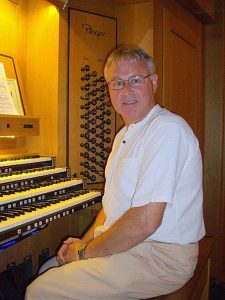 Jeffrey Williams at the Rieger Organ in the Hong Kong Cultural Centre